A first kitchen does not get ruined by one expensive purchase. It gets ruined by forty small ones.
Search for what to put in a first apartment kitchen and you will be handed a list of fifty items, an ad for a starter bundle, and no indication of which things on the list actually matter. Buy all of it and you have spent real money before cooking anything. Buy none of it and you are ordering in for a month.
Here is the shorter version. Two things in a first kitchen are worth spending real money on. Everything else you can buy cheap, find used, or skip entirely until you know whether you need it.
Two things are worth the money
A knife
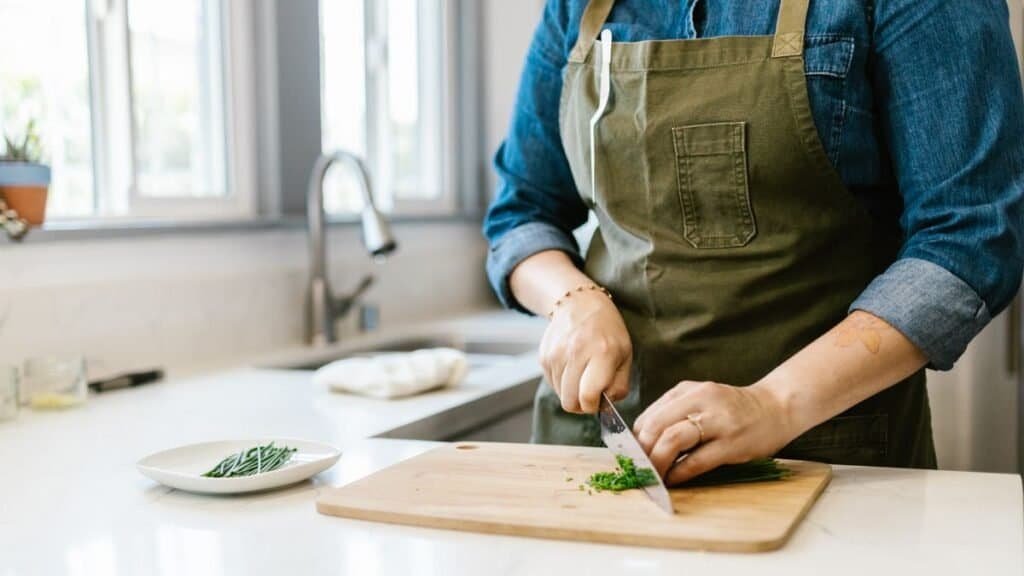
One chef’s knife, around eight inches. Not a set.
This is the item you put your hand on every single time you cook, and a bad one makes prep unpleasant enough that you stop bothering. A blunt blade also needs more force to push through food, and force plus a blade sliding off a hard tomato skin is how people cut themselves.
Skip the twelve-piece block. A knife block is one knife you use, several you do not, and a wooden stand occupying counter space you do not have. If a set is what you find secondhand, take it and use the one good blade in it.
Whatever you buy, buy something to keep it sharp. A sharp inexpensive knife beats a dull expensive one, and dull is where every knife ends up without maintenance.
One heavy pan that can go in the oven
A cast iron skillet, or a heavy-bottomed pot with a lid.
Thin pans have hot spots. Food burns in one place and stays raw in another, and you end up blaming yourself for something the pan did. A heavy pan holds its temperature when cold food hits it, which is much of what cooking well means at this level.
The oven-safe part matters more than it sounds. One pan that works on the stove and in the oven doubles what you can cook without doubling what you own. You can start something on a burner and finish it under heat, which is the technique behind a great many straightforward dinners.
Cast iron is inexpensive relative to what it does, and it is the one item here that can genuinely be a long-term purchase rather than a replaceable one.
What about nonstick?
Get one. Make it the cheap one.
Nonstick coating is a consumable. It wears, it scratches, and eventually it stops being nonstick. Paying a premium for an expensive nonstick pan is paying a premium for something with an expiry date. Buy an inexpensive one, treat it as a five-year item, and replace it without guilt.
Two things to know while you own it. PTFE-coated cookware can begin to break down when exposed to temperatures above about 500°F. The National Capital Poison Center advises against preheating nonstick cookware empty, recommends keeping the kitchen ventilated, and says to replace pans once they are chipped or scratched. Overheated PTFE-coated cookware can produce fumes that cause a short flu-like illness in people and can be fatal to pet birds. Use nonstick on low to medium heat, follow the manufacturer’s instructions, put food or oil in before it heats, and use the heavy pan when you want a hard sear.
The rest of the list
These are the items that make a kitchen functional. None of them justify spending up.
A pot with a lid. Pasta, rice, soup, boiling anything. The lid is not optional. It keeps heat in, which brings water to a boil faster and holds a simmer without the burner cranked up.
Two cutting boards. A small purchase with a real reason behind it. The USDA advises using one board for produce and bread and a separate one for raw meat, poultry and seafood, so bacteria from raw meat does not end up on food that gets no further cooking. On the wood-versus-plastic question, which gets more attention than it deserves, the USDA says either is fine and that nonporous surfaces are simply easier to clean. Buy two cheap ones in different colors and you never have to think about which is which.
One baking sheet. Roasting vegetables, cooking chicken thighs, reheating things from frozen. For what it costs, nothing else in the kitchen covers as much ground.
Plates, bowls, mugs, glasses and cutlery. One set per person, plus a spare. They do not need to match.
A colander, a can opener, a wooden spoon, a spatula, tongs and measuring spoons. The unglamorous layer. Buy the cheapest versions that are not obviously flimsy.
A mixing bowl. One large one does the work of a nested set of five.
That list, plus the two items you spent money on, is a working kitchen. You can cook from it on day one. If you are furnishing the whole apartment and not just the kitchen, the wider first apartment checklist sorts what to buy now, what can wait, and what never needs buying at all.
What this actually costs
The figures below are a worked example to show the shape of the spending. They are not surveyed prices. Costs vary by store, city and season, and you should check what things cost where you shop before budgeting from any number you read online, including this one.
Say you have set aside two hundred dollars for the kitchen. The knife, something to sharpen it, and the heavy oven-safe pan should take the larger share of that. Everything else on the list splits what is left.
The shape of it is the point, not the total. If your spending is spread evenly across thirty things, the budget went to the things you barely notice, and you own thirty mediocre objects instead of two good ones and twenty-eight adequate ones.
Whatever the number is, it is competing with the deposit, the first month’s rent and everything else in your move-in costs, so it helps to know the figure before you start buying. If your number is a hundred dollars rather than two hundred, the answer is not to buy worse versions of the two things. It is to buy the two things and get the rest of the list used or free.
What the starter bundles get wrong
Search this topic and a bundled apartment kitchen kit is advertised at the top of the page and again at the bottom. The problem is how bundles are priced. The headline is the piece count, and the pieces that inflate that count are the cheapest ones to include. A twenty-three-piece set is not twenty-three useful items. It is a few things you would have bought anyway, wrapped around a pile of things you would not.
A bundle is only ever as good as its weakest piece, and the weakest piece is the one they were counting on you not to examine.
The skip list
Single-purpose gadgets. Garlic presses, avocado tools, egg cookers, quesadilla makers. Each does a job a knife and a pan already do, and each occupies drawer space an apartment kitchen does not have spare. If the real problem is that the kitchen is short on space rather than short on gear, our guide to renter-friendly storage in a small apartment is the better place to start.
A matching ten-piece cookware set. You may end up using two of the pans. You are paying for eight to get them.
Specialty bakeware. Buy a cake tin when you have decided to make a cake, not in advance of a version of yourself who bakes.
A stand mixer. A large, heavy, expensive object that earns its place in a kitchen where someone bakes regularly. That is a decision to make later, from evidence.
A full spice rack. Buy spices as recipes call for them. A rack bought in one go can leave you with jars you never reach for and eventually throw out.
A countertop appliance in week one. An air fryer, a slow cooker or a toaster oven can genuinely change how you cook. None needs to be an automatic first purchase. In a small kitchen they cost counter space permanently, and unless you already know which one you use, you are guessing. Wait a month and buy the one you keep wishing you had.
Look for free before you look for cheap
Basic cookware is a good candidate for buying used, because you can inspect it before you take it home. A pot is either intact or it is not, and you can tell by looking.
Buy Nothing groups, local free-cycling pages, family cupboards and the end of a neighbor’s lease are all worth an hour before you spend anything. Moving creates opportunities to pick up usable cookware that is being given away.
Two exceptions. Do not take scratched or chipped nonstick, since wear is the entire problem with that item. And with anything electrical, if you cannot plug it in and test it before it comes home, treat it as a gamble rather than a bargain.
One thing about outlets
Older apartments tend to have few kitchen outlets, and a kitchen collects high-wattage appliances quickly. A kettle, a microwave, a toaster, whatever countertop appliance you eventually buy. The U.S. Fire Administration advises plugging major appliances directly into a wall outlet and never running one off an extension cord, because the cord can overheat and start a fire. Its wider electrical guidance covers the countertop layer too: unplug small appliances when you are not using them, do not overload power strips, and use power strips that have internal overload protection.
It is worth knowing why that gets its own paragraph. The National Fire Protection Association reports that cooking is a leading cause of home fires, home fire injuries and home fire deaths, and that unattended equipment is a factor in about a quarter of home cooking fires and in half of the deaths they cause. The two habits that matter most cost nothing: stay in the room while something is cooking, and give the hungry appliances their own outlet.
After the first month
A month in, you will know things you cannot know now. Whether you cook three nights a week or none. Whether you make coffee at home. Whether the oven in this apartment runs hot. Whether you have once wished for a second frying pan.
That is the moment to spend again, and it is a far better moment, because you will be buying for the person who actually lives there rather than the person you imagined becoming when you signed the lease.
The goal was never to spend as little as possible. It is to end up with a kitchen where the two things you touch every day are good, and nothing else is in your way. The kitchen is one room inside a much longer list of first-apartment decisions, and our First Apartment Guide takes them in the order you meet them.