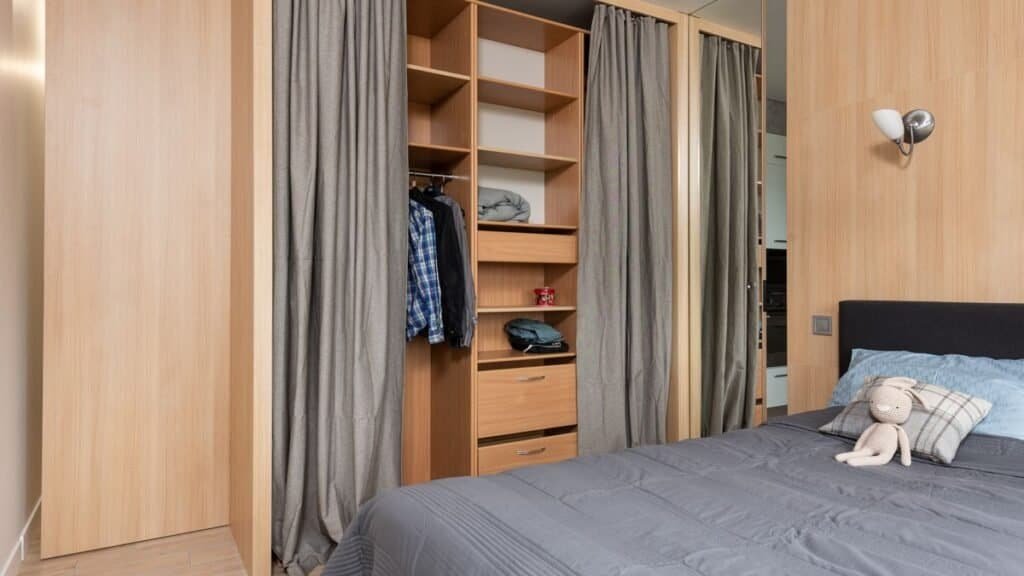
A small apartment does not have a storage problem. It has a volume problem wearing a storage problem’s clothes. Shelves, bins and hooks move your belongings around the room; they do not change how much you own. Buy enough of them and you end up with the same amount of stuff, plus a set of containers you now also have to store.
Storage space is easy to misjudge from listing photos alone — see what to check at an apartment viewing for what to actually measure and open in person before you commit.
That distinction matters more in a rental than it does anywhere else, for a reason that has nothing to do with tidiness. Everything you add to a place you do not own has to come back out again. The walls you hang things on are not yours, the condition you leave them in decides part of what you get back, and the shelf you screwed into the bedroom is either coming with you or being abandoned. The same arithmetic decides every other change you make to a place you do not own, which is why it is worth knowing which renter-friendly upgrades your instructions and your lease actually allow before the drill comes out.
So the question is not how to add storage. It is how to find renter-friendly storage that passes two tests at once: it holds what you have actually decided to keep, and it leaves without a trace.
Do the subtraction pass before you buy anything
Organizing is the second job. The first is deciding what stays, and it is the one people skip because it is unpleasant and produces nothing to photograph.
Work by category rather than by room — all the clothes at once, all the kitchen equipment at once — because that is the only way you find out you own four spatulas. Handle each thing once and put it in one of three places: keep, goes, undecided. The undecided pile is the honest part, and it goes in a box with the date written on it. If you have not opened the box in three months, you have your answer without having to make the decision twice.
Do this before you spend anything on organizers. Storage bought against an unsorted pile is bought against a number that is about to change. And if you are still in the first few weeks of a new place, what to buy first and what can wait is the question that comes before this one.
Two questions that decide every purchase
Once you know what you are keeping, every storage decision in a rental comes down to two questions.
Does it come with me? A freestanding shelf unit moves to the next apartment. A shelf anchored into the wall stays behind, and you paid for it. Furniture, baskets, bins, rods and racks travel. Anything that becomes part of the building does not.
Does it leave a mark? This is the one that costs money, and it is worth understanding exactly where the line sits.
What actually costs you your deposit
Deposit law is set state by state, so there is no single national rule. Texas writes its own version down plainly, which makes it a clear illustration of where the line falls — though the wording that governs you is your own state’s. Section 92.001(4) of the Texas Property Code defines normal wear and tear as deterioration that results from the intended use of a dwelling — and then excludes deterioration that results from “negligence, carelessness, accident, or abuse of the premises.”
Read those four words again, because they are the whole game. Paint that has faded over two years is intended use. Paint that came off the wall in a strip because you yanked a hook straight out is carelessness. The same square inch of wall, two different outcomes. How you installed and removed something is not the only thing that decides which side it lands on — circumstances matter, and so does the person judging it — but it is the part you control.
Texas also states directly that a landlord may not keep any part of a deposit to cover normal wear and tear. Your state’s wording will differ, and it is worth reading before you need it. Either way, what you control is which side of that line your storage decisions land on. If a landlord keeps part of it anyway, getting it back is a separate process with its own deadlines.
One thing worth doing on day one, before any of this: photograph the walls as you received them. A mark you inherited and a mark you made look identical eighteen months later, and the only difference is whether you can prove which is which.
Adhesive hooks and strips: the manufacturer’s own rules
Adhesive hanging strips are the default renter answer, and they work — when they are used the way the company that makes them says to use them. They also fail in predictable ways, and the reasons are printed on the packet. What follows comes from 3M’s own published documentation for Command products, not from a review site.
- They do not stick to brick. 3M’s answer is a flat no — the products are intended for mostly smooth surfaces.
- They do not go on wallpaper. Also a flat no. In 3M’s words: “Most wallpapers are too delicate and can tear when adhesives are applied.” If your rental has papered walls, this whole category is off the table.
- Fresh paint has to cure first. Not dry — cured. 3M’s guidance is to check the paint can for the manufacturer’s cure time, and it recommends waiting a week before using the products on fresh paint. If your unit was repainted between tenants, that clock may still be running on your move-in day.
- Wait an hour before you hang anything. The adhesive needs that time to build its bond. Mounting a hook and loading it immediately is a reliable way to end up with a hook, and some paint, on the floor.
- Do not clean the wall with household cleaner first. This is counterintuitive enough that people do the opposite. Cleaners leave a thin residue that weakens the bond. Isopropyl alcohol is what the instructions call for — but 3M also warns that alcohol may remove or dull the surface of fresh paint, so on a recently repainted wall the answer is to wait, not to scrub.
- You cannot double up to carry more weight. Asked whether extra hooks can hang something heavier than the rating, 3M’s published answer is “No. We don’t recommend it.” Two five-pound hooks are not a ten-pound hook.
- If a strip breaks during removal, dental floss sawed gently behind the hook gets it off the wall without taking the surface with it.
For weight, 3M publishes a reference guide using household comparisons: a pound is a bag of coffee, three pounds is a bag of apples, five pounds is a bag of potatoes, eight pounds is a gallon of milk. Weigh the thing before you trust a hook with it, and choose the rating above what you measured rather than the one that matches it exactly.
The removal technique matters as much as the installation. 3M’s instructions are specific about this: stretch the strip slowly straight down along the wall rather than pulling it toward you. Paint that comes off a wall sits on the carelessness side of that statutory line, so the thirty seconds this takes is the cheapest insurance in the article.
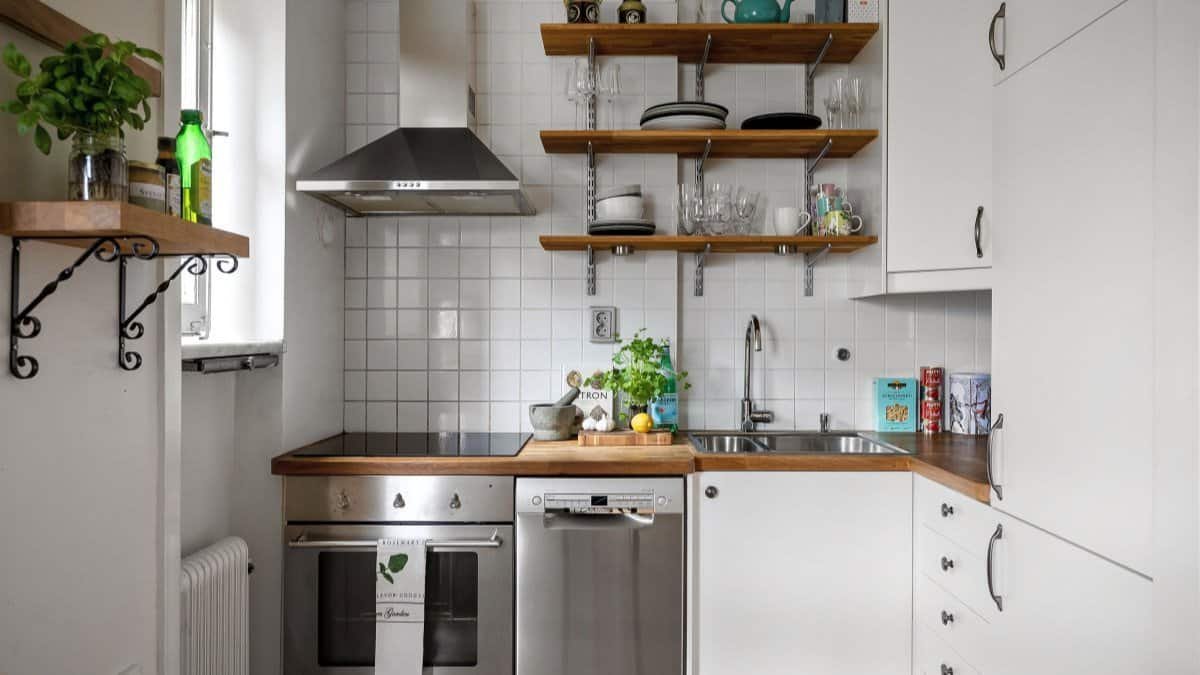
Renter-friendly storage that touches nothing at all
Adhesive is reversible if you are careful. These leave nothing behind even if you are not.
Tension rods hold themselves up with pressure between two surfaces. Under a sink they create a rail for spray bottles. In a closet they add a second hanging level. Across a window recess they carry a curtain without a single hole. They are the cheapest square footage in a rental.
Over-the-door racks convert a surface you were never using into shelving. Doors are vertical space you are already paying rent on and doing nothing with, and the back of a closet door alone can absorb shoes, cleaning supplies or a pantry’s worth of tins.
Under-shelf baskets slide onto shelving you already have and use the dead air above whatever is sitting on it. No tools, no fixings, and they come off when you leave.
Freestanding and leaning units — ladder shelves, narrow bookcases, rolling carts — give you height without any relationship to the wall. A cart that fits the gap beside a fridge is storage that did not exist a minute earlier and rolls out for cleaning.
Tall furniture has to be anchored, and renting is not an exception
Everything up to this point is about leaving no trace. This is the one place where that rule loses, and it is worth being blunt about why.
A tall unit standing free — a bookcase, a shelving tower, a chest of drawers — can go over. The U.S. Consumer Product Safety Commission’s position is not that you should load it carefully. It is that furniture with drawers, doors and shelves should be anchored to the wall. Its national campaign on tip-overs puts it in one line: anchoring “prevents tip-over injuries and deaths.”
Anchoring means a bracket screwed into the wall, which means a hole, which is the thing everything above this has been steering you away from. Take the hole. CPSC’s own guidance anticipates the objection and carries a section for people who are renting or moving, on the basis that anchor holes are straightforward to fill. A filled screw hole is an ordinary repair. What anchoring prevents is not.
If you truly cannot anchor — the lease forbids it in writing, or the wall will not take a fixing — then the answer is not a tall unit loaded low. It is a shorter unit. Buy furniture that cannot reach a child if it comes down.
Measure first, and measure the gaps
The money wasted on storage is mostly wasted on things that did not fit. Before ordering anything, measure three numbers and write them down: the width of the space, its depth, and the height you can use before something blocks it — a windowsill, a radiator, the underside of a shelf.
The gaps are worth measuring separately, because they are where the capacity hides: beside the fridge, between the toilet and the vanity, under the bed frame, above the wardrobe. Those measurements are also what stop you buying a second time. And measure the doorway and the stairwell if the piece is large, because a unit that fits the corner but not the route to the corner is a problem you discover with it half-assembled.
Furniture that stores things, and whether it is worth moving
Storage beds, lift-top tables and ottomans that open are sound in principle: the floor space is already committed, so the volume underneath is free. The catch is specific to renting. A bed frame with drawers is heavier, more awkward on stairs and harder to sell than a plain one, and you may move it more than once in the next few years.
The test is whether the piece earns its removal cost. An ottoman does. A bed frame with integrated drawers is a real decision, not an obvious win. Under-bed bins on wheels give you a comparable volume, cost a fraction, and can be carried out one at a time by one person.
Where the space actually is
Small apartments hide their capacity in the same places.
- The entry. Whatever lands by the door lands there every day. A hook rail and one basket handles the entire problem.
- Vertical kitchen space. The gap between the top of your cabinets and the ceiling, and the dead air above short items on a shelf. Under-shelf baskets and a single riser recover both.
- The closet’s upper third. A rental closet with one rail at one height wastes everything above and below it. A second tension rod and a shelf riser change the geometry without touching the structure.
- Under the bed. The largest uninterrupted volume in a one-bedroom, and the easiest to use badly. Flat wheeled bins with lids, not loose piles.
- The bathroom. Where built-in storage is missing, three places carry it: the back of the door, the wall above the cistern, and the gap beside the vanity. All three take freestanding or tension solutions.
- Behind every other door in the apartment. Not just the closet — bedroom and pantry doors are the same unused surface.
What to skip
Anything that needs a drill — with the single exception of anchoring, above — unless your lease permits it in writing and you are prepared to patch and repaint to a standard someone else judges. Anything sized to this apartment’s exact dimensions, because the next one will be different. Matching container sets bought before the subtraction pass, which is buying the photograph rather than the solution.
And decanting — moving dry goods out of their packaging into identical jars — which looks superb, costs real money, and stores the same volume it did before. If you enjoy it, that is a fine reason to do it. It is not a storage gain, and it should not be sold to you as one.
Before you hand the keys back
Take everything down while you still have time to deal with what is underneath, not on your last evening. Remove adhesive strips by stretching them slowly down the wall rather than pulling outward. Photograph each spot afterwards.
If something did lift, deal with it before the inspection rather than waiting to be charged for it. A wall that has already been touched up puts you in a different conversation from one that has not.
The record you made when you moved in is what turns all of this into evidence rather than argument. Storage that leaves no trace is only worth something if you can show the trace was never there. For where storage sits among everything else a first rental asks of you, our First Apartment Guide takes the stages in order.
Sources
- 3M, Command Products FAQs — surfaces, wallpaper, brick, paint curing, the one-hour wait, surface cleaning, and hanging above the rated weight.
- 3M, Command Products Weight Limits Guide — the published weight references.
- Texas State Law Library, Security Deposits — the statutory definition of normal wear and tear at Tex. Prop. Code § 92.001(4), and the bar on deducting for it at § 92.104.
- U.S. Consumer Product Safety Commission, Anchor It! — the federal tip-over prevention campaign, including its own guidance for people who are renting or moving on filling anchor holes.